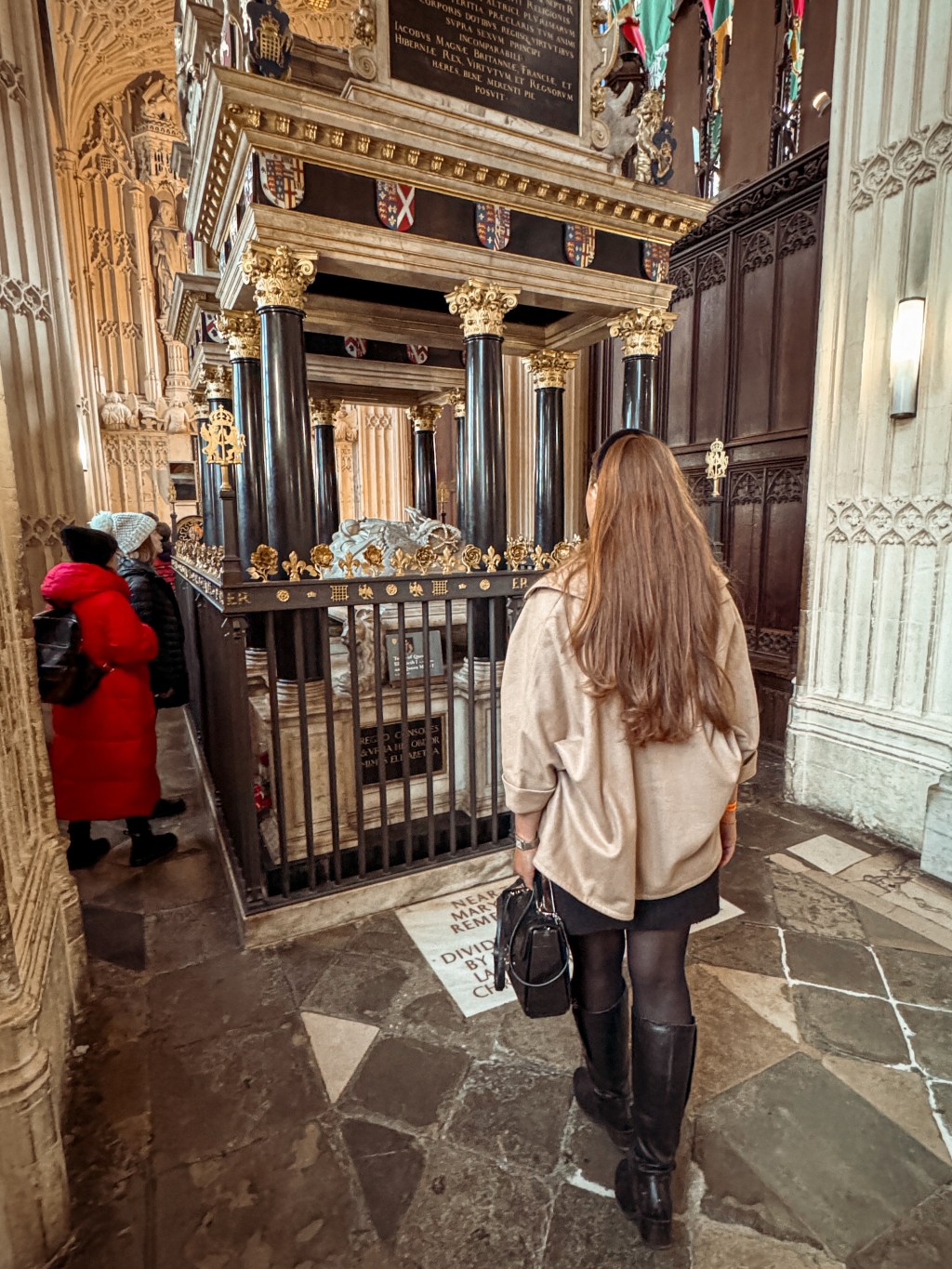
Visiting Westminster Abbey is a truly magical experience for a history lover. It’s incredible to think that the very foundations of this country can be geographically pinpointed to an area smaller than a football field. Not to mention that within it lie the graves of over 3,300 people, all who had an important role to play in shaping the very fabric of Britain’s history and culture, including some of the most important scientists, writers, and monarchs to have ever lived. The thought covers me in goosebumps!
I decided to focus this post specifically on Medieval and Tudor monarchs, as there are simply too many names to cover, but will pop down some other notable graves below. I couldn’t take pictures in certain parts, so credits go to Westminster Abbey.
Edward the Confessor & Edith

In the centre of the Abbey lies its founder, Edward the Confessor, considered patron saint of England before St George. His shrine was elaborately decorated with jewels and was known as a place of miracles, attracting countless pilgrims.
However, due to his popularity his grave was disturbed many times, including having a hair off his beard attempted to be plucked off by the Bishop of Rochester (he failed and was reprimanded), having his robes and famous sapphire ring removed by Henry II (the sapphire now sits in the Imperial State Crown), and after some scaffolding fell on his coffin having his crucifix and chain taken by James II (which were both subsequently stolen by fishermen when James was escaping England).
If that wasn’t enough for poor Edward, during the Dissolution of the Monasteries, his body was taken out, his shrine melted down and all the jewels were given to Henry VIII. Henry’s daughter, Mary Tudor restored Edward’s body and donated jewels to replace those that had been removed (although these have since also been lost), as well as constructing the tiered wooden canopy above it. Hopefully he won’t be disturbed again!
The chapel is only accessible through the guided Verger tour (see details below) due to the floor’s fragility, but is definitely worth seeing. His wife Edith is buried nearby.
Henry III
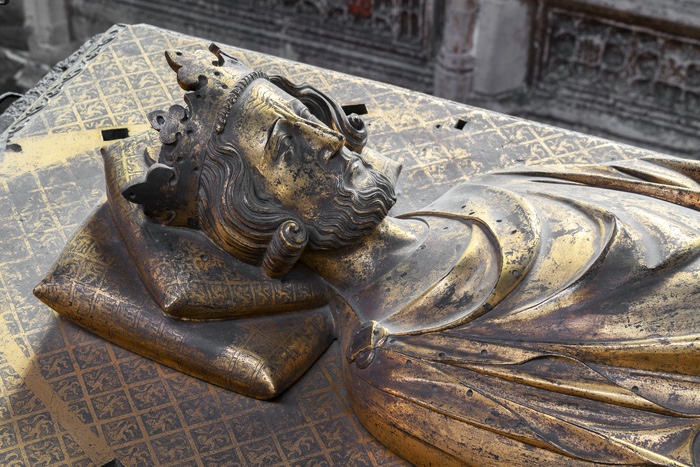
Henry assumed the throne aged only 9, and although his rule was marked with political instability, he was one of England’s longest-serving monarchs and is known for his contributions to medieval architecture and culture. Henry was also pivotal in reconstructing the Abbey in the Gothic style that we associate it with today.
His tomb is adorned with an effigy of gilt brass and covered in Purbeck marble – which is not technically marble, but a dense variety of limestone found in the Purbeck Hills of Dorset, which would have been dark and solemn with a high polish. It is used on many tombs in the Abbey.
His wife, Eleanor of Provence, died much later in Amesbury Priory in Wiltshire and was buried there in an unknown grave, making her the only English queen without a marked grave.
Edward I & Eleanor of Castile

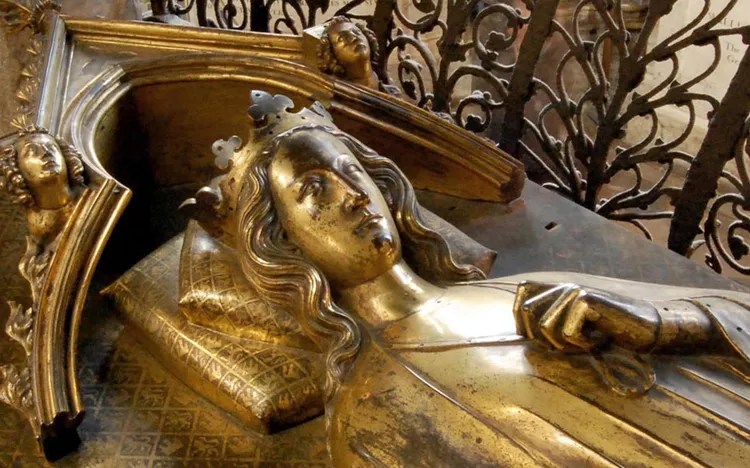
Edward I, was known as ‘Longshanks’ because he was 6’2″, when the average man was 5’7″, and was also nicknamed the ‘Hammer of the Scots’ – because of his brutal wars with Scotland – think back to the mean king in Braveheart.
Unlike the other tombs around him, his is incredibly plain. This may be due to him wanting an unfussy, military style tomb, or possibly due to how controversial he was (to avoid drawing too much attention/damage). Another theory suggests that he wanted it to be easily accessed so his bones could be removed in future, to be boiled and taken on crusade!
Eleanor of Castile is buried next to him. She played a big role in politics which was unusual for a Queen at the time and frequently managed stately affairs while Edward was off fighting wars. By all accounts they had quite a happy marriage and Edward was so devastated by her death that he commissioned the Eleanor Crosses, twelve Gothic style stone sculptures which marked the nightly resting-places along the route taken when her body was transported to the Abbey (the most elaborate being Charing Cross, which gave the area its name!).
Edward III & Philippa of Hainault
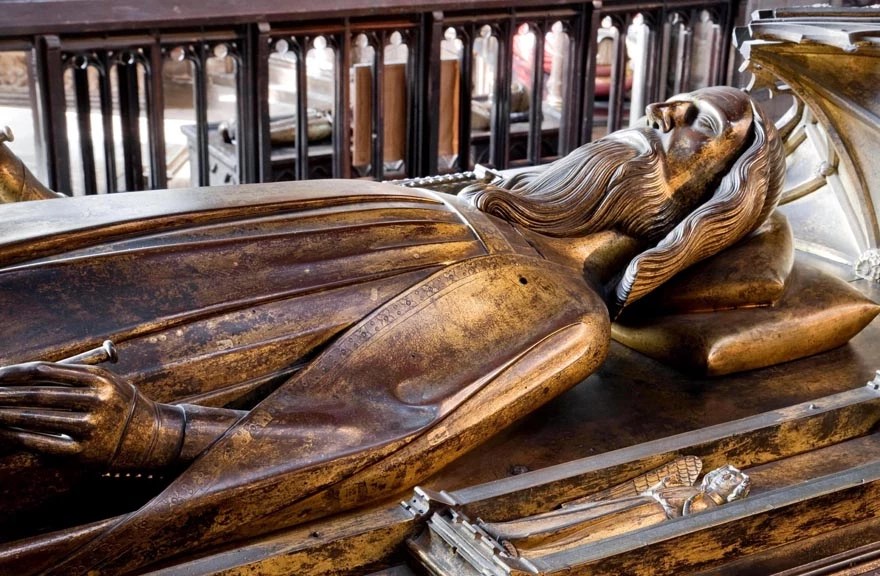

One of the greatest medieval Kings, Edward III was known for his military successes, particularly during the Hundred Years’ War against France. His victorious battles established England as a major European power and contributed to the growth of English nationalism. He was also known for developing English Common Law and was a patron of the arts, supporting poets like Geoffrey Chaucer.
His tomb also features a Purbeck marble base and an effigy, likely modelled on a death mask. He is dressed in armour, a nod to his military achievements, and his tomb is adorned with Gothic elements and heraldic insignia, representing Edward’s lineage and status.
Next to him lies his queen Philippa of Hainault in an alabaster effigy. She acted as regent when Edward was off at war and fostered alliances between England and various European powers, including her native Hainault, which helped strengthen England’s position in international affairs.
Richard II & Queen Anne of Bohemia

Richard came to the throne at just 10 years old and had a bit of a God complex. Although he was a commanding ruler, he wasn’t a particularly great king by all accounts, but to be fair he didn’t have much time to prove himself as he was captured and likely starved to death by Henry IV aged just 33.
He lies beside his first wife, Queen Anne of Bohemia who died of the plague aged only 28. Unlike most effigies where the deceased would be clasping their hands in prayer, they are buried alongside each other and are meant to be holding hands – how romantic!
Henry V & Catherine de Valois

Henry V, was one of the most famous medieval warrior kings, and had a remarkable victory over the French at the Battle of Agincourt despite the English army being outnumbered four to one. Sadly his legacy was marred by an untimely death at just 35 from dysentery – not a great way to go. He has a modest tomb with an elaborate chantry chapel above, where priests once sang for his soul.
His queen, Catherine de Valois is buried nearby under an altar in the chantry, but this part of the church isn’t really accessible. Fun fact about Catherine – she had an affair with a Welsh commoner Sir Owen Tudor (who was Henry Tudor’s father and established the Tudor dynasty!).
Henry VII & Elizabeth of York

Henry Tudor, known for being the founder of the Tudor dynasty, was known for his shrewd financial management, which restored the solvency of the crown and ended the War of the Roses (effectively a civil war) by marrying Elizabeth of York.
They are buried side by side in a magnificent chapel with gilt bronze Renaissance effigies crafted by Pietro Torrigiano.
Edward VI
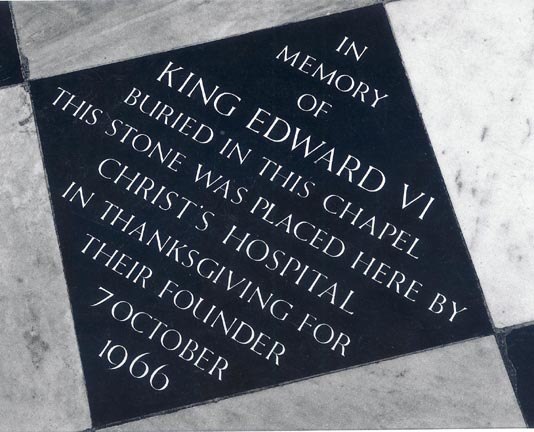
The only son of Henry VIII, Edward VI succeeded his father at only 9 years old. Unfortunately, he was a very sickly child and died of tuberculosis aged just 15. Due to the succession crisis and religious turmoil that occurred after his death, he was buried in an unmarked spot until he finally received a stone in 1966.
Mary Tudor & Elizabeth I

Mary Tudor aka ‘Bloody Mary’ was England’s first anointed queen. Daughter of Henry VIII and his first wife, the Spanish Queen Catherine of Aragon, Mary was a staunch Catholic and reigned over a period of deep religious unrest. She was buried in the Abbey without an effigy, and her half-sister Elizabeth I’s coffin was placed on top of hers.
Elizabeth I happens to be my favourite monarch. As most will know, her mother was beheaded by her very own father who completely abandoned her, as a teenager she was undoubtedly molested by her step father and mother, and to top it off she narrowly avoided being executed by her half-sister and being assacianated by her cousin. Once she came to the throne she had all the princes of Christendom wanting to marry her so they could control the country, yet famously remained a ‘Virgin Queen’.
Despite all her hardships, she was one of England’s longest reigning monarchs, bringing peace between Catholics and Protestants and leading the country to victory over the Spanish armada. The long, proseprous and peaceful reign that followed ushered in a time of the golden Elizabethan age, inspiring some of the country’s greatest cultural achievements (Shakespeare), as well as the begining of globalisation and international trade (including the arrival of the potato to Britain!).
Her face is also likely to be a death mask, so resembles what she looked like when she died. I felt deeply moved standing next to her tomb, having known about her incredible life and finally being so close to her.
Mary Stuart, Queen of Scots
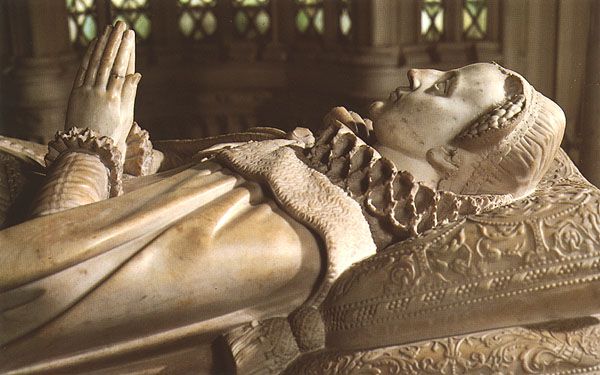
Known as the great rival of Elizabeth I, Mary had a tumultuous life marred with conflict between Catholics and Protestants as well as power struggles with her own Scottish nobles. She was forced to abdicate her Scottish throne in favour of her infant son James (who later unified England and Scotland under one monarch) and fled to England.
When she arrived in England she expected support from her cousin Elizabeth I, but instead was imprisoned for nearly two decades, as she was seen as a Catholic rival with stronger royal links to the English throne. Mary foolishly proceeded to take her revenge by plotting to assassinate Elizabeth, for which she was found guilty of treason and sentenced to death.
Her son James never got to know his mother, but built her an elaborate tomb in the Abbey to commemorate her. Some say it is even grander than that of Elizabeth’s – judge for yourself!
Visiting Westminster Abbey – Top Tips
Book tickets in advance and preferably in winter to avoid all the tourists (it’s also a perfect rainy-day activity), we went in late February and the cathedral was still fairly busy. Tickets are £29 for an adult and can be booked online, but I HIGHLY recommend paying an additional £10 to get a ‘Verger Guided Tour’. This lasts for 90 minutes and gives you access to the Tomb of St Edward the Confessor, which isn’t accessible to general visitors.
Tours run on most days except Sundays, and you can call the Abbey directly to check the tour guide times, and purchase them at the ticketing desk inside. When we arrived for our 1pm entry in late February we had half an hour to explore the cathedral and take photos before the tour began at 1:30pm. Our Verger (who reminded me a lot of Mr. Bean haha) took us around the entirety of the cathedral and explained everything in the most incredible detail.
If you’re not just a one off visitor, make sure to ask the staff to upgrade your ticket to an annual pass. They will issue you with a new paper ticket for free that you can use to visit up to three times in one year, without even needing to pre-book. This is really handy as there is far too much to see here in just a few hours!
There is also a separate museum up the stairs called the ‘Queen’s Diamond Jubilee Galleries’ which you can save for the next trip. It’s £5 and includes 300 treasures from the Abbey, including the Westminster Retable (1259–69), the oldest surviving altarpiece in England from Henry III’s time.

 Ever so British
Leave a comment